Through much of 2025, a half-built house sat on private acreage along lower McDonald Creek near Apgar Village, framed and sided but empty through a Montana winter. It looked like an ordinary construction delay. It wasn't. That house was the physical form of a legal question nobody in Flathead County could answer with confidence: who actually governs private land inside Glacier National Park?
On April 17, 2026, the Ninth Circuit Court of Appeals answered it. And the answer explains something that trips up nearly every buyer who starts comparing West Glacier listings to the rest of the valley: why homes here run small in square footage and enormous in price.
The House That Forced the Question
John and Stacy Ambler, a couple from San Diego, bought a small lot near Apgar in 2019 and began building a three-story home there in 2022. The lot sits on what was once a 182-acre tract homesteaded by Charles Howe in 1908 under the Homestead Act, two years before Glacier National Park existed. Land like this, private property that predates the park and never sold to the federal government, is called an inholding. Roughly 115 of them remain inside Glacier's boundary today, most clustered along the shores of Lake McDonald, with a handful more up the North Fork near Big Prairie.
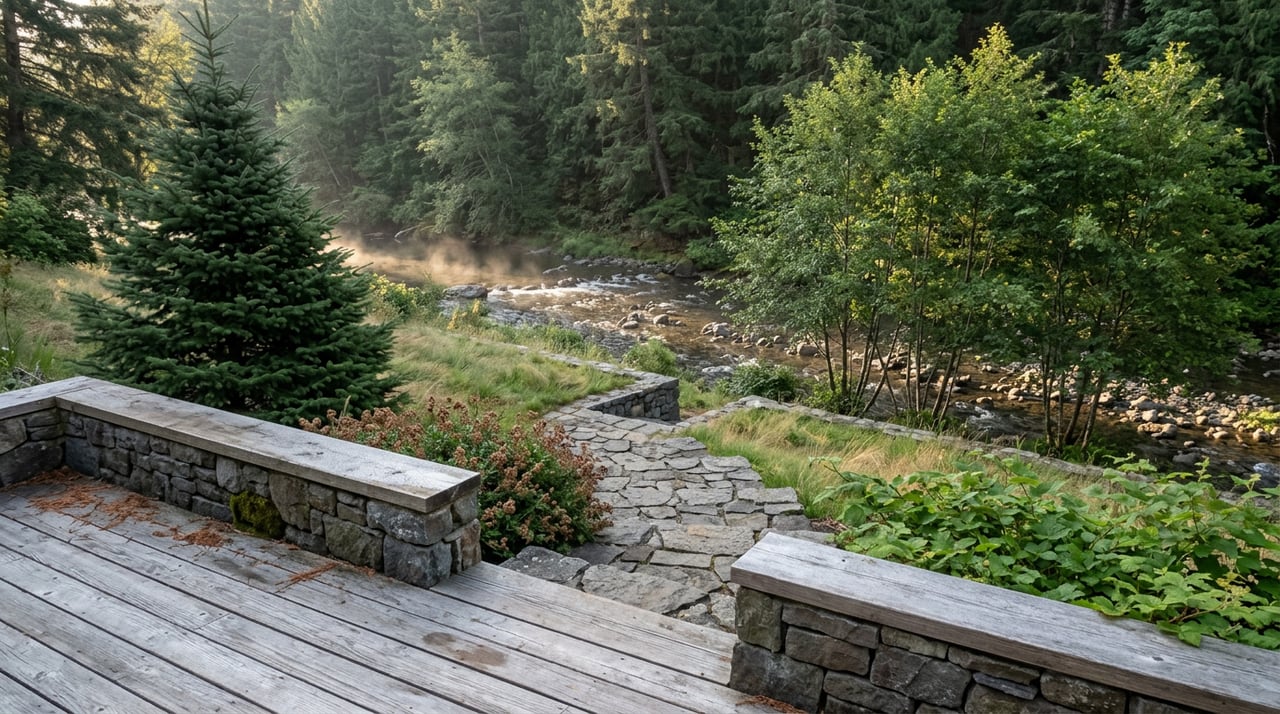
The Amblers' lot is tiny, just over 2,300 square feet, and construction required excavating the creek's streambed to pour a concrete retaining wall. When neighbors noticed, they alerted the Flathead Conservation District, which cited Montana's 1975 Natural Streambed and Land Preservation Act, known locally as the 310 law, and ordered the home removed by April 2024. The Amblers refused and sued, arguing the district had no authority at all inside the park.
They were right, at least according to two federal courts now. In February 2025, U.S. Magistrate Judge Kathleen DeSoto in Missoula ruled that Montana ceded jurisdiction over private inholdings to the federal government in 1911, and the United States accepted that cession in 1914. The Ninth Circuit's April 2026 opinion reaffirmed the point, with the panel writing that "federal authority became the only authority operating within the ceded area," including "privately owned lands within the described park boundaries." The state's 1975 streambed law, the panel found, was never assimilated into federal law because it wasn't in effect when Montana handed over jurisdiction decades earlier.
The Park Service had already allowed the Amblers to connect their home to the water and sewer system that serves Apgar Village. That detail matters more than it might seem, because it shows the federal government was never absent from this property. It just wasn't operating through the channel everyone assumed.
Not a Free Pass, a Different Rulebook
Coverage of the ruling in the days after tended to flatten it into "couple gets to keep their house." A Hungry Horse News editorial pushed back on that framing, arguing the decision settled who has authority over inholdings, not whether any oversight applies to them. As the paper put it, the ruling is "not a free pass," but rather "a shift in responsibility."
That distinction is the one worth sitting with if you're evaluating property near the boundary. Nothing about this ruling means construction, streambank alteration, or utility work on an inholding is now unregulated. It means the regulator is the National Park Service, operating under federal standards, not Flathead County or the conservation district. For a property type this rare, that clarity is arguably more valuable than the ruling itself. Buyers, sellers, and lenders finally know which door to knock on.
It also has a ripple effect beyond the Ambler property. Pursuit, which owns a cluster of rental cabins just upstream on McDonald Creek, had separately applied to the conservation district for a permit to rebuild aging structures there. That application now sits inside a framework the courts just clarified, which is likely to matter for how quickly aging inholding structures throughout the park can be replaced or renovated.
The Math That Doesn't Add Up Until You See the Ceiling
Here is the number that stops most buyers cold. In July 2026, homes listed for sale in West Glacier carried a median price of about $4.2 million, working out to roughly $4,182 per square foot. Meanwhile, active listings in the area averaged only around 1,796 square feet, well under the broader county average of 2,614 square feet.
Small homes, enormous prices. The instinct is to chalk this up to a national park proximity premium, the same logic that makes a condo near Old Faithful cost more than an identical unit forty miles away. That instinct is only half right. Proximity explains a premium. It does not explain why the premium is this steep on homes this small, or why comparable lakefront property elsewhere in the Flathead Valley, larger, newer, equally scenic, trades for a fraction of the per-square-foot price.
The missing piece is supply that cannot expand. Most of Glacier's original private land was bought out or ceded to the Park Service across the past century. What remains is fixed at roughly 115 parcels, a number that only shrinks over time as remaining inholdings are eventually acquired, never grows. A 1.55-acre inholding on Lake McDonald with 103 feet of shoreline and a modest two-bedroom cabin built in 1968 went on the market in 2024 for $15 million. Two years earlier, a separate inholding home near the lake had listed for $7 million. Neither price reflects finish quality or lot size the way a typical luxury comp would. Both reflect the fact that this kind of land simply cannot be created again.
Inholding Versus Everything Else in West Glacier
Not every parcel near the park boundary is an inholding, and the distinction changes the entire transaction.
| Inholding (inside park boundary) | Standard parcel (outside boundary) | |
|---|---|---|
| Governing authority | National Park Service, federal jurisdiction | Flathead County, standard state and county process |
| Available inventory | Fixed at roughly 115 parcels, cannot expand | Ordinary market supply, subject to zoning and development |
| Utility connections | Often tied to Park Service infrastructure serving Apgar Village | Local utility providers and county well and septic rules |
| Comparable sales | Extremely thin, with recent listings ranging from $7M to $15M | Broader comp pool across West Glacier, Coram, and Belton |
If you're comparing a listing near Apgar to one a few miles out along Belton Stage Road, you are not comparing two versions of the same market. You are comparing two different regulatory worlds that happen to share a zip code.
What This Means If You're Actually Looking
Ask early whether a parcel predates 1910 and was never sold to the Park Service. That single fact determines the entire permitting path for any future construction, remodel, or streambank work, and it explains why a listing's price per square foot might look nothing like the property two lots down.
Expect a thin comp pool. With roughly 115 of these parcels in existence and turnover rare, pricing an inholding leans more on specific past sales than on a broad market average. The $15 million and $7 million listings mentioned above are still useful reference points, but each one is closer to a one-off transaction than a market trend.
Budget time for federal review rather than a county permit process if you plan to build, rebuild, or alter anything near a stream. The Ambler case took three years to resolve through two federal courts before the jurisdictional question was settled. Actual construction review going forward should be far more routine now that the pathway is clear, but it is still a federal pathway, with its own timeline and its own office.
A Few Straight Answers
Does this ruling affect property outside Glacier's boundary, like most of West Glacier village or Coram? No. The ruling addresses jurisdiction over private inholdings inside the park's ceded boundary specifically. Property outside that line still falls under normal Flathead County and Montana state authority.
Does federal jurisdiction mean there's no oversight at all on inholding land? No. It means the Park Service, not the conservation district or the state, is the reviewing authority for construction and streambank work. As Hungry Horse News put it, the ruling is a shift in responsibility, not a removal of it.
How often do inholdings actually come up for sale? Rarely. With roughly 115 remaining and most held long term, a handful of comparable listings over several years, rather than dozens per season, is the realistic expectation.
If you're weighing a property near Glacier's west entrance, whether it's an inholding with its own regulatory path or a parcel just outside the boundary with a more conventional one, the distinction is worth understanding before you write an offer, not after. You can browse current listings and local context on our West Glacier neighborhood page, and if you'd like to talk through what a specific property actually is before you get attached to it, Alida Tinch is happy to help you sort it out. Let's Connect.